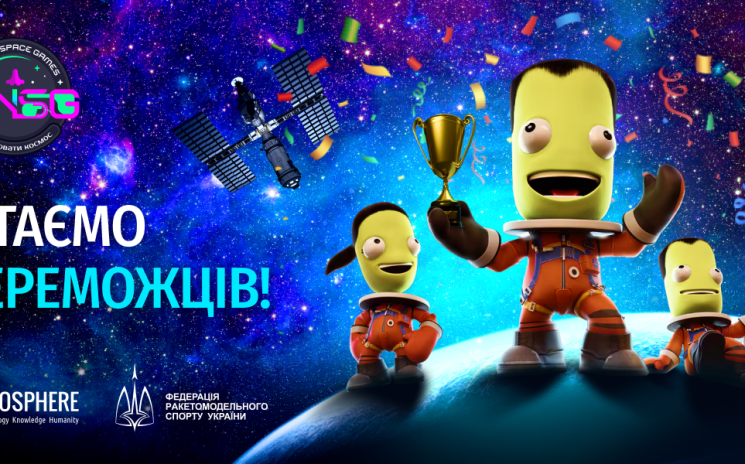
Nearly 500 Ukrainian school and university students have completed their participation in the Noosphere Space Games — a nationwide virtual rocket modeling competition that combines STEM education, hands-on engineering challenges, and a safe online format. Participants worked on tasks inspired by real space missions while building skills that matter for the country’s future technological development.
Gaming as a Learning Tool
All projects were created in Kerbal Space Program, one of the world’s most well-known space flight simulators. The game accurately models real physical processes such as aerodynamics, orbital mechanics, engine performance, fuel consumption, and module interactions in space. That’s why Kerbal Space Program has been used for years as a STEM learning tool and in educational programs related to aerospace engineering.
“Our goal is to show that space is closer than it seems, and that engineering starts with play and experimentation. By piloting spacecraft in Kerbal Space Program, children learn how to plan missions and make their first technical calculations — which is already the first step toward real engineering achievements,” say the organizers of the Noosphere Space Games.

A Format Designed for Today’s Reality
The Noosphere Space Games have been held since 2022 and were created as an alternative to traditional offline launches, which are currently impossible due to safety restrictions and closed airspace. The online format makes it possible to keep technical education going and to involve children and young people from all regions of Ukraine.
Participants work with tools that simulate real space missions: they design spacecraft, plan flights, perform orbital dockings, and handle emergency scenarios. This approach not only sparks interest in space but also gives participants their first hands-on experience with engineering tasks and complex technical systems.
The Noosphere Space Games are part of a broader ecosystem of space creativity and STEM education developed in Ukraine by the NGO Noosphere Association. The project aims to popularize technical and space-related disciplines, promote a STEM-based approach to learning, and help shape a new generation of innovators ready to work with the technologies of the future.
“When the country’s focus returns to peaceful development and space exploration, we will need a new generation of specialists. Through competitions like this, young people get introduced to engineering and modern technologies, gain practical skills, and begin to see themselves as part of the future of science and the space industry,” the organizers add.
How the Competition Worked
This year’s competition lasted two months. All participants worked on a single mission — a virtual space rescue operation. The task required them to design a spacecraft, calculate a flight trajectory, perform an orbital docking with a damaged station, and safely return the crew to the planet. While the goal was the same for everyone, the solutions varied widely: each participant chose their own design approach, spacecraft configuration, and mission strategy.

“The most interesting part for me was using the available resources as efficiently as possible — both the rescue ship’s fuel and the station’s monopropellant. It required precise calculations and patience, but these are exactly the kinds of challenges that help you better understand how space systems work,” says Marko Parokhin, who won in two categories. “Even though my school studies aren’t directly related to engineering yet, I’m already working on my own projects — radio-controlled model airplanes and drones — and I plan to pursue further education in aerospace engineering. Kerbal Space Program played a big role in inspiring that choice.”
After two months of work, the organizers announced the winners, who will share a total prize fund of $2,200.
Winners
Easy Mode
- Marko Parokhin (15, Brovary)
- Kyrylo Moroz (12, Kyiv)
- Artem Kobets (14, Kropyvnytskyi)
- Pavlo Shtyl (13, Zhytomyr)
- Matvii Sobchenko (11, Sviatopetrivske)
Expert Mode
- Marko Parokhin (15, Brovary)
- Bohdan Borovyk (22, Kyiv)
- Mykhailo Shtyl (20, Zhytomyr)

“The Noosphere Space Games are a great example of how virtual tools can deliver real educational results. Every year, we see the quality of the projects and the depth of engineering solutions grow. For many participants, this competition becomes the starting point of a professional path in technical and aerospace fields,” says Denys Khmil, Secretary General of the Ukrainian Spacemodelling Sport Federation.
This year’s Noosphere Space Games are just the first step in a long journey into the world of space technologies. Many new challenges, exciting missions, and opportunities lie ahead — all designed to help Ukrainian school and university students develop the skills needed for real-world space and engineering projects.