On October 4–5, the world once again united for the NASA Space Apps Challenge — the largest international hackathon dedicated to space exploration. Space enthusiasts from over 160 countries took part in local events held in hundreds of cities across the globe.
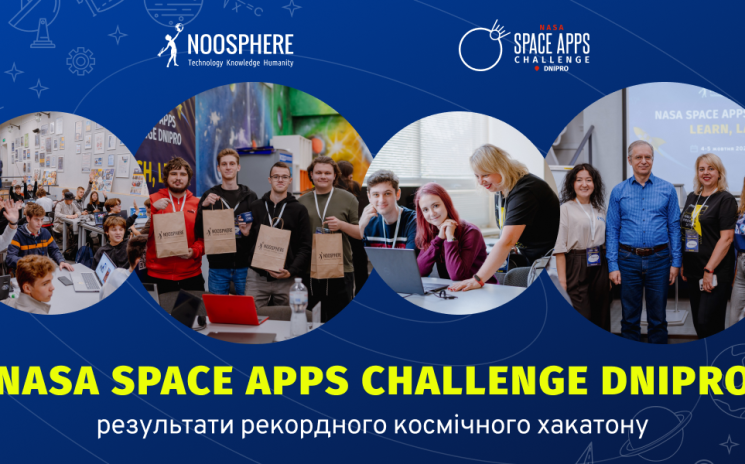
This year, Ukraine hosted three locations — in Kyiv, Odesa, and Dnipro. And the Dnipro stage, organized for the ninth time by Association Noosphere, broke national records, becoming the largest location in Europe with 434 participants forming 90 teams. This achievement placed Ukraine 1st in Europe and 47th globally among 555 locations.
The event took place both online and offline at the Noosphere Engineering School labs in Kyiv, Dnipro, Rivne, and Cherkasy. Participants joined from all across Ukraine, as well as from the USA, Germany, Slovakia, and Poland. The youngest contenders — 6th and 7th graders from Kherson — amazed the judges with their creativity and fresh ideas.
Over the course of 48 hours, teams developed and presented 83 innovative projects to the jury. Their work covered diverse topics: from space biology, satellite data visualization, and exoplanet research to agricultural analytics, educational platforms, and science-based games for kids.
Eight standout projects from the Dnipro location were nominated to represent Ukraine on the global stage:
StarUnity — a program that allows users to design various space station habitats, adjusting size, geometry, and interior layout.
Einstein’s Sect — creators of Aurora Garden, an educational game where players care for a farm affected by space weather.
Space Writers — authors of a science-inspired fairy tale that helps children and adults understand space weather and the origins of auroras.
Genova — a web platform that aggregates NASA data for farmers, providing modeling tools and decision-making scenarios for crop management. The team became Dnipro winners for the second time.
TurboNova — developers of the SBiology Search Engine (SBSE), a tool for navigating large-scale scientific data and improving access to reliable sources in space biology research.
Zephir — creators of Terra Tools, a 3D interactive app that visualizes real-time and historical satellite images from NASA’s Terra mission.
KPI_IASA_SOM — an interactive platform for exoplanet analysis that combines automated data processing with dynamic visualization.
Interstellar_ExoVision — a platform powered by AI for exploring, classifying, and visualizing exoplanets.
These projects — along with the winners from other locations worldwide — will now be reviewed by NASA’s global jury. In November, the organizers will announce the Global Finalists Honorable Mentions — the top 40 teams — followed by the 10 global winners in January.
The global winners will receive an exclusive opportunity to meet one-on-one with a NASA scientist, share their projects, and discover the latest scientific advancements from inside the agency.