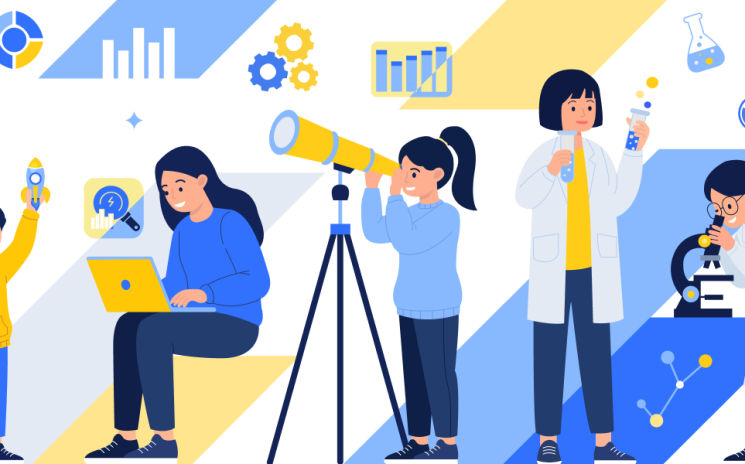
Science is diverse, fast-moving, and full of discovery. It’s where new ideas are born and where our understanding of the world can completely change. We know many women whose names are written into the history of global science. And yet, stereotypes about “male” and “female” fields still exist. To celebrate the International Day of Women and Girls in Science, we spoke with participants of Association Noosphere projects. These young women chose STEM fields and prove every day that talent and hard work have nothing to do with gender.

Daryna Provolovska is a Master’s student in Astrophysics at Taras Shevchenko National University of Kyiv. She teaches physics at a private school and astronomy in several extracurricular clubs. She also runs a blog to spark young people’s interest in astronomy. Outside of science, she enjoys photography, videography, learning piano, and making beaded jewelry.
This fall, Daryna took part for the fourth time in the local stage of NASA Space Apps Challenge in Dnipro. Her team, Einstein’s Sect, won first place — their second victory at the local level.
The team created a children’s game about space weather.
“We wanted to explain what space weather really is – and to show that magnetic storms don’t cause headaches,” Daryna says with a smile. The game is set on a Ukrainian farm. What would happen if space weather hit a modern, highly digital country like Ukraine? During blackouts, we’ve seen how much depends on electricity. In extreme space weather, equipment wouldn’t just stop working – it could burn out.
In the game, a grandfather and grandson work together to figure out why things break down – like a tractor, for example. It combines detective storytelling with real science. Although the team didn’t win at the global level, they plan to continue developing the project.
As a teacher, Daryna believes that students’ interest in STEM depends heavily on the teacher. “Around 30% of students are genuinely interested in technical subjects. That’s actually a good number – higher than when I was at school,” she says.
Still, stereotypes remain.
“No matter how accomplished you are, there will always be people who try to undermine you,” she explains. “Many girls at school may not even realize they’re interested in physics or math – because they’re told those subjects aren’t for them.”
She recalls a teacher training where a male speaker told a room full of women that a certain car model would interest boys more than girls. “These are respected scientists with PhDs. Yet the bias is still there — and often they don’t even see how harmful it can be.”
Daryna does the opposite: she encourages girls to explore their full potential. If a student loves animals but has strong physics skills, she suggests looking into biophysics. “You can save animals and understand how medical devices work. You don’t have to choose just one path.”
She draws inspiration from women like Iryna Vavilova, Head of the Department of Extragalactic Astronomy in Ukraine, and Jocelyn Bell Burnell, who discovered pulsars — though her supervisor received the Nobel Prize for the discovery.
“Her strength amazes me,” Daryna says about Bell Burnell. “I don’t know if I could have handled that. But she kept going.”
Daryna hopes science in Ukraine will one day receive the respect it deserves. “Without respect for science, it’s hard to build real gender equality,” she says.

Seventeen-year-old Kateryna Savchenko is a student at Lyceum No. 1 in Pavlohrad. She also attends an electronics club at the Junior Academy of Sciences. She loves drawing, reading, and programming small personal projects.
Last summer, she joined Noosphere Tech Intensive 2.0 summer school. It changed her mindset.
“For the first time, I felt how an idea stops being abstract and becomes a real project with a mission,” she says.
In the fall, Kateryna participated in NASA Space Apps Challenge in Dnipro — her first hackathon.
“It was a huge event for me. You think on a global scale: how can this idea work for humanity? I gained teamwork experience under time pressure, presentation skills, and confidence that any idea deserves a chance.”
Her team designed a closed-loop system to recycle inorganic waste for Mars missions.
“We asked a simple question: what do you do with waste where resources are limited and you can’t send trash back to Earth?” she explains. Their system sorts, processes, and regenerates materials using mechanical and chemical methods. Waste becomes new panels, containers, tools, and even parts of living modules. Water and heat are reused, and emissions are minimized.
Despite the challenges Ukraine faces today, Kateryna focuses on opportunities. She sees education as a privilege, not a burden. Her family and friends are her main source of support.
She has encountered stereotypes — the idea that girls are better at humanities and boys at technical subjects — but says it never influenced her.
“Everyone should follow what excites them. The world needs diversity in science and technology — different perspectives, experiences, and ways of thinking.”
She is inspired by women like Maggie Aderin-Pocock and Katherine Johnson for their contributions to space research, as well as Emma Watson for promoting education and equality. She also finds motivation in young women on social media who openly share their journeys in STEM.
Kateryna is still deciding on her future path. She’s interested in cybersecurity, game development, and computer engineering. One day, she dreams of launching her own game development company — creating interactive projects that tell meaningful stories and inspire users.

Fifteen-year-old Anastasiia Lysenko is a 10th-grade student at Zaporizhzhia Regional Academic Lyceum “Kozatskyi.” She’s passionate about biology, programming, and computer graphics. She enjoys combining science with creativity — exploring how the brain works while experimenting with digital design.
This fall, she participated for the second time in Noosphere Space Games, a virtual rocket modeling competition.
“I’m inspired by the community — their passion for rocketry and the excitement of submitting missions in the last few minutes,” she says. She especially enjoys the screenshot contest. Through the competition, she learned about orbital mechanics, docking, apocenters, and pericenters — and how complex yet fascinating the journey from idea to launch can be.
Her family is her biggest support system. She also draws strength from music, creativity, and friends. And she expresses deep gratitude to Ukraine’s defenders. “Because of them, I can live, study, and dream in Ukraine. That motivates me to keep going and contribute to the future.”
Among the women who inspire her is Sieda Vlasova, an education leader in Zaporizhzhia who creates learning spaces for teenagers. “She shows how one person can change their environment and help young people believe in themselves.”
Anastasiia hasn’t personally faced gender bias, but she believes the best way to challenge stereotypes is through knowledge, persistence, and results.
She hopes to build a career in medicine, possibly as a neurosurgeon. “I’m fascinated by neuroscience. I want to help people and expand our understanding of how the human brain works.”
The Noosphere team is inspired by girls and women who challenge stereotypes, advance Ukrainian science, and prove that talent has no age or gender. We wish every girl the support of loved ones, the respect of society, and success in any field she chooses.